From the NotoriousOnline news archive. First published on September 27, 2005. It describes events as they stood then. This version is rewritten in our own words from the original report and credits it.
Almost ten years after the March 1997 murder of Biggie Smalls, only one posthumous album of unreleased, pieced-together material had appeared, 1999's Born Again, and it was poorly received. Yet the Notorious B.I.G. seemed to draw more respectful mentions and public salutes than ever.
That summer he was on the cover of Vibe, received a long if showy tribute from his producer and friend Puff Daddy at the MTV Video Music Awards, and was quoted or invoked by rappers ranging from Jay-Z to Cassidy.
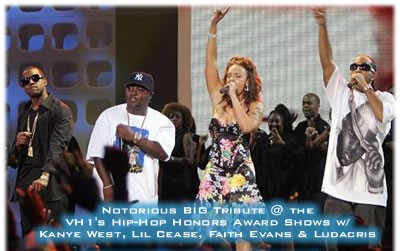
VH1 added another honor with its second annual Hip Hop Honors. The show, taped in September 2005 at Hammerstein Ballroom, was set to air at 9 p.m. Biggie was among the honorees, along with LL Cool J, Big Daddy Kane, Grandmaster Flash, Ice-T, Salt-n-Pepa and the film Boyz N the Hood. Russell Simmons, who hosted, said the poetry, wit and creativity of Biggie's delivery had inspired many rappers, himself included.
Art was only part of the explanation. Elliott Wilson, editor of XXL, pointed to a fascination with death, comparing Biggie's case to Elvis Presley's: "We're fascinated with death." Erik Parker, music editor of Vibe, noted that unlike Elvis, Biggie died at the height of his fame. "We want to continue to bask in what he could have been," Parker said.
Biggie released only one album in his 24 years, the 1994 debut Ready to Die. The double album Life After Death came out in March 1997, soon after his still-unsolved murder. He therefore never had time for the usual career missteps. Wilson called Life After Death a benchmark that set the template for how many hip-hop artists balanced commercial songs with harder ones.
Wilson also tied the growing respect to changes in hip-hop itself. He described Biggie as part of a dying breed of true lyricists who continued the East Coast tradition of Big Daddy Kane and LL Cool J, with dense lyrics full of metaphors and similes, and as a great storyteller. That contrasted with crunk and the Dirty South sound, where the beat and the hooks often overshadow the words.
More of his words were on the way. For the tenth anniversary of his death, a long-planned tribute album that included unreleased rhymes was due by the end of the year, and the following month, October 2005, his mother, Voletta Wallace, would publish a book about him. Parker did not expect the tributes to stop, comparing Biggie to Marvin Gaye, whom people also keep bringing back to keep him alive.